At Europe Biobank Week (EBW26), we presented our latest work on FISMA and its practical applications within biobanking. Our contributions included one oral presentation and two poster presentations.
EBW is the largest biobanking networking event in Europe, bringing together experts from healthcare, academia, and industry to discuss new developments, emerging challenges, and cutting‑edge innovations. The congress offers a high‑quality scientific programme and highlights state‑of‑the‑art biobanking research.
A key part of EBW is organized by BBMRI-ERIC, the European research infrastructure for biobanks.
Oral Presentation
In the presentation entitled “Curated registration at the source yields RWD for many purposes”, Roger Snijder shared our experiences and solutions for making Real‑World Data interoperable and reusable as is—ensuring it is FAIR from the start. The presentation is available for download: EBW2026_Presentation_A practical approach to FISMA for high quality and interoperable RWD.pdf (2,43 MB)
Poster Presentations
The first poster “Nation-wide FAIR Biomaterials” demonstrates how the nationally used protocols for isolating blood and urine samples, applied for many years across the Netherlands, have now been made openly available according to open science principles. It also visualizes how many LUMC samples this applies to and highlights the added value of FAIRification through curation at the source for the clinical data and biomaterial. To support transparency and reuse, the underlying protocols can now be found, checked, and used directly via the links below. More, such as the national biobank protocols on RNA- and urine isolation, plus renewed protocols, will follow soon:
- Plasma protocol — National Biobank Standard Protocol for Plasma Isolation from Whole Blood in Dutch University Medical Centers
- Serum protocol — National Biobank Standard Protocol for Serum Isolation from Whole Blood in Dutch University Medical Centers
The poster is available for download: EBW 2026_Nation-wide FAIR biomaterials.pdf (778,51 KB)
The second poster “FISMA‑governed registration at the source in Duchenne-Becker Biobank” describes the implementation of FISMA at the point of data generation. It shows how biomaterials, linked to a rich set of clinical data, can be extracted directly from HIX and Sample Navigator, within their clinical context and in a fully traceable manner, based on registered patient consent.
The poster is available for download: 2026 EBW_FISMA governed registration at the source in Duchenne-Becker Biobank.pdf (633,64 KB)
Authors and Contributors
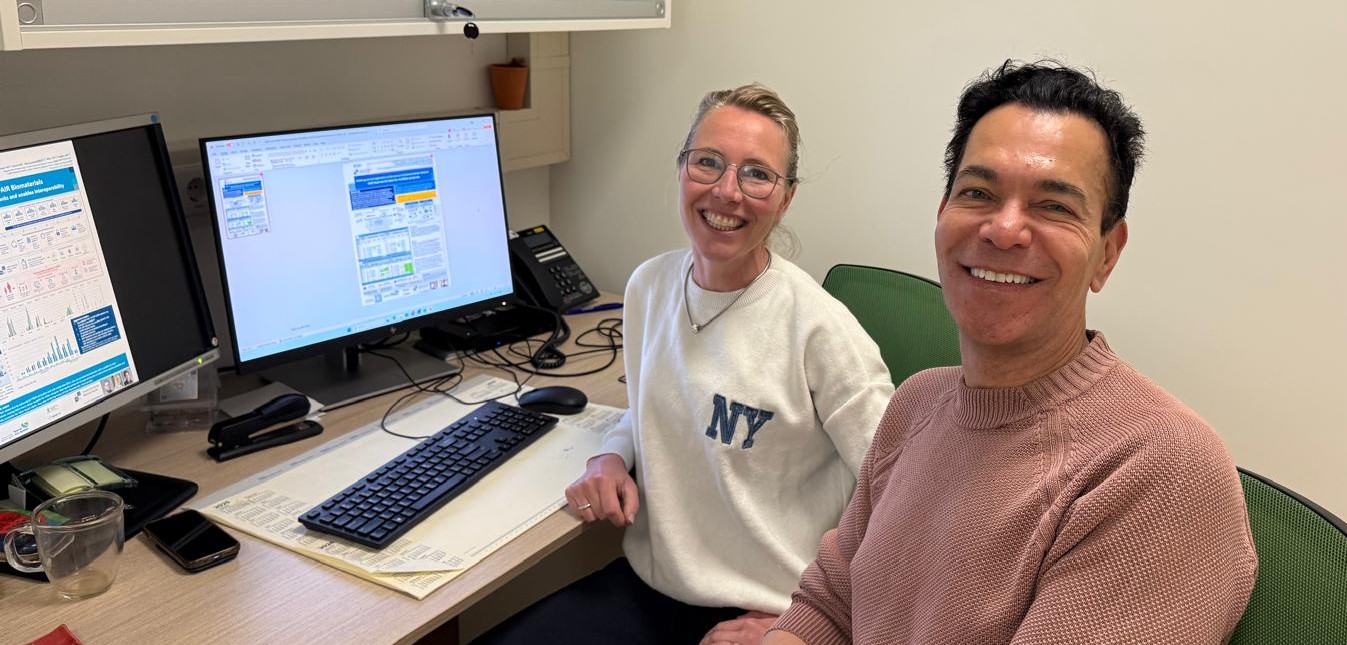
These presentations and posters were developed by Roger Snijder and Yvonne Meijer‑Krom, and presented live by Roger.
Biography
Roger Snijder
Roger Snijder has been working for LUMC, Leiden University Medical Centre, since 2007. His first assignment was representing LUMC during the National Biobank meetings, and consulting LUMC on the implementation of nationally agreed policies regarding these national multicentre biobanks as information architect for the integration of research into healthcare – a position he holds to this day. Later, he also joined the organisation of National Biobanks as national coordinator of information architecture. As one of the Dutch champions of semantic interoperability (as FAIR was originally known), Roger is a staunch forefighter for clinical context and curation at the source, as is evident in his brainchild FISMA*, an information model for Real-World Data. Fully employed by LUMC Biobank Organisation, Roger offers consultancy on methodology and information architecture for Duchenne Centre Netherlands (DCN), and more recently, the chairman for research in the new EHR for LUMC, as well as a senior consultant regarding research architecture for the LUMC data platform. He is one of seven architects who are drafting the architecture for the re-use of health data for secondary use as part of European Health Data Space (EHDS). Roger represents LUMC as an information architect, and IT consultant for Biobanks at the Health RI / BBMRI NL initiative.
*FISMA is a joint effort of Yvonne Krom & Erik Niks of Duchenne Center Netherlands, and Roger Snijder
Yvonne Krom
Yvonne Krom is the coordinator for both Duchenne Center Netherlands and the Pediatric Neuromuscular Center at Leiden University Medical Center (LUMC).
Her work spans a broad range of responsibilities, including project management, overseeing the neuomuscular biobank, managing registrations, and strengthening national networks to establish standards of care for Duchenne.
She plays a key role in developing research and data infrastructures, such as the FISMA framework, which enables high‑quality, interoperable, and reusable healthcare data for both care and research. Through her coordination and project leadership, she works to improve care pathways, treatment options, and research opportunities for Duchenne and Becker patients in the Netherlands.
*Duchenne Center Netherlands is a collaboration between the expert centers LUMC, Radboudumc and Kempenhaeghe (the center for neurological learning disabilities) and the patient organization Duchenne Parent Project, and the patient association Muscle Diseases Netherlands.
RWD for NeuroMuscular Diseases | Linktree. Paper en digital extraction showcasing of FISMA is in process